Special Topic丨Research On The Evolution Trend Of Artificial Intelligence Empowered Software Forms
※A think tank for information society policy research※※A vane at the forefront of information and communication technology※
About the author
Qin Sisi
Senior engineer at the Artificial Intelligence Institute of China Academy of Information and Communications Technology. His main research directions are intelligent software engineering, large model engineering, MLOps, MaaS, etc.
Yan Dongwei
Corresponding author. Engineer at the Artificial Intelligence Research Institute of China Academy of Information and Communications Technology. His main research directions include the development path of intelligent software engineering technology, series of standard preparation, evaluation, and consulting.
Qi Kexin
Assistant engineer at the Artificial Intelligence Research Institute of China Academy of Information and Communications Technology. His main research directions are intelligent software engineering and MLOps. He is mainly involved in series of standard preparation, evaluation, consultation and other work.
Cheng Yang
Engineer at the Artificial Intelligence Research Institute of the China Academy of Information and Communications Technology. His main research directions are artificial intelligence, blockchain, digital dual carbon, open source, etc. He is mainly responsible for relevant standard preparation, evaluation, and project research.
Paper citation format:
Qin Sisi, Yan Dongwei, Qi Kexin, et al. Research on the evolution trend of artificial intelligence empowered software forms. Information and Communication Technology and Policy, 2025, 51(8): 64-70.
Research on the evolution trend of artificial intelligence empowered software forms
Qin Sisi Yan Dongwei Qi Kexin Cheng Yang
Institute of Artificial Intelligence, China Academy of Information and Communications Technology, Beijing 100191
summary:
With the rapid development of artificial intelligence technology, especially the breakthroughs made by large models in fields such as natural language processing and computer vision, traditional software development paradigms, architecture design, interaction mechanisms and deployment methods are undergoing unprecedented changes. In-depth exploration of the impact of artificial intelligence technology represented by large models on the evolution of software forms; systematic analysis of the internal mechanism of large models driving software to evolve toward intelligence, as well as the core characteristics of new software forms; focusing on the requirements of intelligent grading, a software intelligence maturity model and corresponding implementation plans are proposed; the technical bottlenecks, security risks, ethical dilemmas and engineering challenges faced by software evolution in the era of large models are elaborated, and its future development direction is prospected, providing a reference for theoretical research and practical exploration of the evolution of software intelligence.
Keywords:
artificial intelligence; large model; software; intelligence; software engineering; software form
0Introduction
In the development of human science and technology, every innovation in computing paradigms is accompanied by a profound evolution of software forms. From early batch processing systems in the mainframe era, to desktop applications in the personal computer era, to distributed systems in the Internet era and mobile applications in the mobile Internet era, software has always been the core engine driving social progress. Currently, mankind is at a new technological singularity, the beginning of the era of large models. Large language models represented by GPT, Claude, Gemini, etc., as well as multi-modal large models covering image, audio and other information, rely on their hundreds of billions or even trillions of parameter scales, massive training data, and excellent generalization capabilities to demonstrate unprecedented understanding, generation, reasoning, and autonomous learning capabilities. Such breakthrough developments are rapidly penetrating into every aspect of software and its production, fundamentally changing the definition, production methods, operating logic and even the interaction model with users of software. Traditional software is centered on logic and code, and developers define software functions through explicit programming; in the era of artificial intelligence represented by large models, data has become a new core asset, models constitute a new core architecture, and software has begun to possess stronger self-learning, self-optimization, and adaptive capabilities.
Therefore, in-depth study of the impact of large models on the evolution of software morphology has important theoretical and practical value. This not only helps reveal the nature of current technological changes and predict the future development direction of the software industry, but also helps software companies explore new growth points in fierce market competition, and provides guidance for developers to master and adapt to new development paradigms.
1 big model empowers software form changes
For a long time, software has always been based on running rule-based code and has taken on a fixed form. However, in recent years, artificial intelligence technology represented by large models has made breakthrough progress, promoting rapid changes in software forms. Its core characteristics have transformed from "rule-driven" to "cognitive-driven" and have gradually evolved around multiple dimensions such as architecture design, interaction methods, application models, and development paradigms.
1.1 Evolution of software architecture
Driven by the dual drive of technology iteration and complexity of business requirements, software architecture is undergoing a fundamental transformation from "artificial construction" to "intelligent emergence". As shown in Figure 1, traditional software architecture uses code as the core carrier. Developers rely on programming languages such as C++ and Java to build monolithic architecture, vertical architecture, and service-oriented architecture (SOA) by designing the calling relationships between functions, classes, and modules.
or microservice architecture
wait. In this mode, software capabilities are strictly limited by preset logic, although cloud native technology
The rise of IT has improved its flexibility and scalability, but its essence is still in the "rules-driven" category. Developers still need to invest a lot of energy in dealing with underlying technical details and business logic, and the complexity of the architecture continues to increase with the expansion of business scale.
Figure 1 Software architecture evolution
The era of intelligence promotes the reconstruction of software architecture, and models replace codes as the core of the new architecture.
. The architecture system uses the large model as the "digital brain" and the intelligent body as the "executive limb", so that software functions can be realized through prompt word programming, and the amount of code is significantly reduced. The developer's role has been transformed from "logic writer" to "capability scheduler". With the help of the agent collaboration framework, module calls in the traditional architecture are transformed into capability scheduling of large models and autonomous collaboration of agents. This type of architecture has dynamic evolution characteristics. Continuous learning based on user feedback enables the continuous evolution of models and software capabilities. The game and collaboration between multiple agents can spontaneously form complex functions, ultimately achieving a qualitative change in "intelligence emergence."
1.2 Changes in interaction methods
As shown in Figure 2, the transformation of human-computer interaction from command line interaction (Command Line Interface, CLI) to graphical user interface interaction (Graphical User Interface, GUI) has achieved a major breakthrough, and is currently moving towards natural language dialogue interaction.
The evolution of software has once again constituted a staged leap. In the future, multi-modal human-computer interaction forms will further improve the efficiency and accuracy of interaction between humans and software.

Figure 2 Evolution of software interaction methods
As the basic form of human-computer interaction, traditional CLI requires users to accurately remember and input specific commands and parameters, and the technical threshold is high. By introducing graphical elements such as windows, icons, menus, and pointers, GUI has significantly lowered the threshold for users to use it. It not only promotes the widespread popularization of personal computers, but also catalyzes the vigorous development of the software industry. Currently, the rise of large language models is driving human-computer interaction to undergo a new round of paradigm shift, with natural language dialogue interaction gradually becoming the main interaction form of new forms of software. Natural language dialogue interaction combines the flexibility of CLI in expressing complex intentions with the ease of use of GUI at the operational level, allowing users to initiate instructions, obtain information, confirm results or complete tasks through natural language dialogue, significantly improving interaction efficiency and the naturalness of user experience, and achieving optimization and upgrade of interaction methods.
In the future, human-computer interaction will be centered on user intentions and further evolve towards multi-modality and non-influence. Interaction forms such as voice, gestures, eye movements and even brain-computer interfaces will become increasingly mature. Interaction entrance forms will also undergo fundamental changes, and the invocation of software capabilities will be more situational.
1.3 Changes in application models
Large models are driving the migration of software application models from process automation to cognitive intelligence. Traditional software is rule-driven and focuses on the automated execution of specific data and predetermined business processes. Its core value lies in simplifying repetitive operations. Typical scenarios such as Enterprise Resource Planning (ERP) systems can greatly improve the execution efficiency and management standardization of each business by streamlining and automating finance, procurement, production and other links. However, such systems rely on preset rules and explicit input. When requirements or conditions change, the software code needs to be modified to adapt to new scenarios, resulting in limited flexibility and generalization.
As the semantic understanding, knowledge reasoning, and context awareness of large models gradually increase, "cognitive drive" is becoming the core competitiveness of software in the new era. In the future, software will break through the limitations of preset steps and be able to proactively understand user intentions, process massive amounts of heterogeneous data, and generate, execute and complete user needs based on complex reasoning and decision-making. Software is leaping from automated process tools to collaborators or operators with intelligent decision-making and execution capabilities. For example, traditional intelligent driving systems may contain hundreds of thousands of lines of C++ code, while the code volume of current intelligent driving systems based on large models can be reduced by 90%.
, and at the same time realize the perception of various environments, judgment of intelligent driving conditions and operational decisions through large models.
1.4 Changes in R&D paradigm
Since its birth in 1968, software engineering has experienced three leap-forward evolutions, and its research and development paradigm has also changed accordingly.
. The Software Engineering 1.0 era (1968-2001) focused on waterfall delivery and built a strict R&D system to promote software engineering on a disciplined and process-based standardized path. However, there were problems such as lengthy delivery cycles and low demand response efficiency. In order to break through the efficiency bottleneck of the traditional model, agile development promotes software engineering to enter the 2.0 era (2001-2022), achieving rapid iteration through continuous integration (Continuous Integration, CI) and continuous delivery (Continuous Delivery, CD) to adapt to increasingly changing needs.
Since 2022, with the rise of large model technology, software engineering has gradually moved towards the 3.0 intelligent era
. Large models bring reshaping changes to the entire software development life cycle, realizing intelligent upgrades in the entire chain of demand understanding, code generation, testing and verification, operation and maintenance, and promoting changes in organizational structures. Taking intelligent coding as an example, it has gradually transformed from the initial partial code generation into a coding agent. It realizes engineering-level coding for programming technicians and can solve engineering-level coding problems, further improving the anthropomorphic programming experience. At the same time, "atmosphere programming" is more acceptable to ordinary users and can help users generate applications or software only through natural language conversations. The era of "everyone is a developer" is just around the corner, and the software research and development paradigm is undergoing fundamental changes. In the future, software or applications that use large models as operating systems will be widely popularized.
1.5 Reconstruction of product form
The big model is reconstructing the form of software products from the underlying operating system to upper-level enterprise-level applications and even personal productivity tools. The role of the operating system is evolving from a platform that passively manages hardware resources (CPU, memory, storage) to a core hub that actively senses user intentions, intelligently schedules resources, and delivers services on demand. Empowered by large models, the operating system can directly analyze users' fuzzy or colloquial needs, and automatically disassemble and transform them into precise underlying resource scheduling instructions, achieving a qualitative change from "command response" to "intent-driven".
The database revolution lies in upgrading from an engine focused on ultra-large-scale data storage and efficient retrieval to a "data value engine" with real-time computing, complex reasoning and intelligent decision-making capabilities. The core of traditional databases lies in structured queries, and the multi-modal data processing and analysis capabilities endowed by large models enable it to transform from a static data warehouse into a dynamic computing and reasoning center. For example, the e-commerce platform database can analyze user browsing behavior characteristics in real time, combined with historical purchase records, to proactively generate personalized recommendation strategies.
Enterprise-level applications (such as ERP and CRM) are undergoing a transformation from tool software that performs preset processes and functional operations to "business intelligence partners" that deeply understand the business, proactively gain insight into value, and assist or even drive decision-making optimization. On the one hand, it can automate repetitive business tasks such as contract drafting and financial report generation; on the other hand, it can unify and coordinate multi-department resources such as R&D, production, and sales to achieve overall intelligent management and process optimization. Personal productivity software (such as office suites, conferencing tools, and text editors) has been reshaped from efficiency tools that provide basic and convenient functions to "intelligent collaborators" that can deeply understand user intentions and collaborate on creation. For example, document tools can generate a complete outline based on fragmented ideas and continue to write text imitating the user's style. Conference software can intelligently manage schedules, automatically coordinate time, and assume the role of an efficient work assistant.
Overall, large models are driving the evolution of software form from "function executor" to "intelligent agent", profoundly changing the form of software products and value creation methods.
2Software intelligent implementation solution
In order to promote the implementation of software intelligence, provide reference for intelligent transformation enterprises, and help the software industry achieve progressive evolution, this article constructs a software intelligence maturity model and summarizes the corresponding implementation paths.
2.1 Software intelligence maturity
As shown in Figure 3, software intelligence maturity evolves step by step from L1 to L5. This article defines five levels from the dimensions of interaction mode, degree of autonomy, and task complexity.
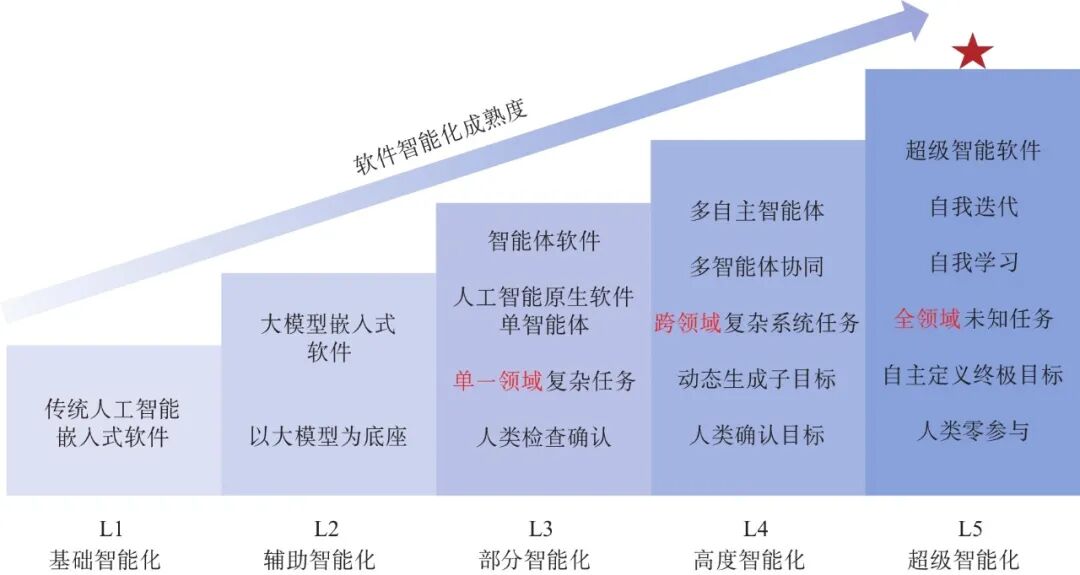
Figure 3 Software intelligence maturity classification
As shown in Table 1, L1-level intelligent software is characterized by fixed content generation and fixed interaction methods (such as buttons and forms), and mainly relies on traditional machine learning models to run. Typical scenarios include traditional customer service robots, face recognition systems, etc. This type of software lacks dynamic learning capabilities and requires manual guidance throughout the process. It is suitable for low-complexity and highly repetitive tasks. L2-level intelligent software introduces natural language dialogue interaction (such as multi-turn dialogue) based on large models, which can understand user intentions and provide auxiliary support for humans. Typical scenarios include intelligent search, code generation tools, etc. This type of software requires deep human involvement (such as confirming or modifying generated content) and is suitable for task processing in knowledge-intensive scenarios. L3-level intelligent software can generate multiple modalities (such as text, images, speech, etc.), and handle complex tasks in a single field through plug-in knowledge bases and based on agents. Typical scenarios include coding agents, native artificial intelligence applications, etc. This type of software requires humans to participate in decision-making in key links (such as result review and confirmation). L4-level intelligent software has the ability to process cross-domain complex systems and achieve strong adaptability through multi-agent autonomous collaboration and dynamic knowledge base invocation. This type of software requires humans to set initial goals and optimization goals. L5 level represents the ultimate form of intelligent software, which can autonomously complete unknown tasks in all fields (such as scientific discovery). It is based on multi-dimensional environmental perception of the physical world and achieves self-iteration without intervention through global knowledge base and self-learning, with "zero participation" of humans.
Table 1 Intelligent software maturity classification characteristics
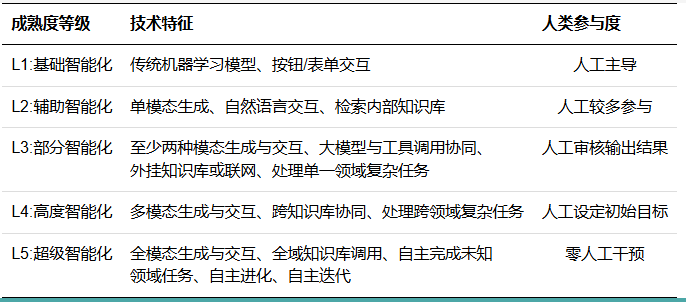
There are significant key differences between the levels. L1~L2 realizes the transformation from "rule-driven" to natural language interaction; L2~L3 transitions from intelligent assistance to agents to realize intelligent upgrades in a single field; L3~L4 breaks through the limitations of a single field and solves system-level problems through multi-agent collaboration; L4~L5 has the ability of self-iteration and cross-domain self-learning, and then moves towards general artificial intelligence.
2.2 Software intelligent implementation path
At present, intelligent technology is still in the rapid iteration stage. When implementing intelligent software upgrades, enterprises still need to follow the core principles of business value drive and adhere to the "three-step" implementation path. That is to say, first select high-value scenarios for internal diagnosis and planning; secondly implement intelligent capabilities according to goals and inject "intelligence"; and finally carry out continuous operation of software intelligent capabilities to maintain "intelligence."
Planning stage: First, carry out multi-dimensional self-diagnosis, which specifically includes two aspects: first, technical capability diagnosis, to clarify the company's strengths and weaknesses in artificial intelligence technology; second, infrastructure capability diagnosis, to gain an in-depth understanding of the company's existing computing resources, storage resources, data resources, etc., and to clarify the company's capability positioning through self-diagnosis. Secondly, screen high-value scenarios. By analyzing the pain points, bottlenecks and potential growth points in current business processes or existing software applications, combined with data analysis and survey results, it is clear which software or links can best achieve efficiency improvement, cost reduction or user experience optimization through intelligent technology, and simultaneously determine the specific goals and expected results of software intelligent capability upgrades.
Implementation stage: Develop implementation plans based on enterprise capability positioning and planning goals, and configure corresponding intelligent tools and technologies through procurement, development, introduction, etc. On the one hand, the existing software is intelligently transformed, focusing on improving the three dimensions of intelligent interaction, intelligent decision-making, and intelligent collaborative execution; on the other hand, it is newly developed artificial intelligence native software, using new thinking, new models, and new frameworks in the big model era to design software requirements and implementation paths to meet user needs while expanding its application boundaries.
Operation stage: Continuously maintain and improve software intelligence capabilities by establishing a long-term optimization mechanism for software. First, monitor the reasoning effect of the large model and the effectiveness of the software application, and learn in a timely manner whether there is degradation in the large model, and whether the effect of the large model on software business functions has changed; secondly, collect feedback data of software applications in real time or regularly, establish a "data flywheel", and clarify problems and optimization directions based on data analysis; finally, build a maintenance and update mechanism for large models and software.
3Opportunities and Challenges
3.1 Opportunities
The process of application innovation is accelerated to help enterprises improve their competitiveness. The software production process is characterized by high efficiency and low threshold, the capabilities of large models continue to increase and the cost of calling continues to decrease, and the software form becomes more flexible and intelligent, which further promotes the process of software reconstruction and innovation. On the one hand, software functions based on large models as operating systems are more modular, scene-based, and adaptive. User experience upgrades are achieved through diversified interaction modes, giving rise to more super application software. The intelligent transformation of software products has become an inevitable trend. According to Gartner's 2025 forecast, 33% of enterprise software will contain agent-based artificial intelligence by 2028, while this proportion will be less than 1% in 2024
. On the other hand, based on a more efficient intelligent R&D paradigm, companies can quickly generate software prototypes, iterate software functions, and respond to user needs, thereby quickly seizing market opportunities.
Productivity has been significantly improved, promoting enterprises to reduce costs and increase efficiency. Through various software development tools such as intelligent integrated development environment (IDE) and coding agents, software productivity has been greatly improved. For professional R&D personnel, coding assistants have become a core tool for improving efficiency; for ordinary users, "atmosphere programming" tools are gradually becoming a software development tool that is both convenient and professional. This will not only push traditional software companies to provide more software products and services and meet more user needs based on their existing staff size, but will also spawn more small software companies. Such companies may be more competitive with the support of emerging technologies such as large models. For example, the organizational structure of software projects will evolve from team operations to individual operations, and more software developers will focus on design and high-innovation value work.
The industrial structure is accelerating upgrading, driving the intelligent transformation of enterprises. First, large models will become the core content of the software industry chain, injecting new vitality and innovation power into the industry, and building an important foundation for the intelligent transformation of software. Second, the "moat" of traditional software companies has become shallower. For example, software outsourcing services are facing transformation pressure. The demand for traditional outsourcing may continue to shrink, while the demand for data annotation, prompt engineering, etc. will gradually increase. Third, the long-tail demand of the software industry is expected to be alleviated. In the era of "everyone is a developer", solutions to the segmented needs of various industries will be more feasible and economical.
3.2 Challenges
Challenges at the data level are mainly reflected in the following: software-related data such as code is subject to privacy and security regulations, open and closed source agreements, etc., resulting in high data acquisition costs and complex and diverse types. According to TIOBE index statistics, as of June 2025, there are currently more than 280 programming languages.
. This makes the industry lack a large number of code data sets for model training. Especially in scenarios such as embedded code in the industrial field, the shortage of data sets is more prominent. In addition, there is also a shortage of industry software data, which requires software companies to build high-quality industry software data sets based on scenario attributes and existing data accumulation, laying a foundation for intelligent software to adapt to different industries and scenarios.
Challenges at the security and ethical levels are mainly reflected in the following: while large models inject high-value capabilities into software, they also bring uncertainty. Especially in scenarios with low risk tolerance, more new risks will be faced around the three levels of data, model and software. In this regard, software companies can respond from three aspects. The first is to strengthen risk prevention from sources such as data and models to reduce the "illusion" problem in model reasoning and decision-making processes; the second is to add "safety fences" from the software level to resolve some uncertainties through engineering means; the third is to reserve controllable space for humans in the process of continuous intelligentization of software, such as setting up functions such as "automatic sliders" to allow humans to independently choose the degree of intelligence to avoid potential deep ethical risks.
Challenges at the talent level are as follows: Talent is the key to the intelligent transformation of enterprise software. In terms of talent training, companies need to reshape their organizational culture, build an ecosystem of open collaboration and continuous innovation, and break down information barriers. At the same time, they need to improve the awareness of artificial intelligence among all employees. They must understand the potential of large models and recognize their boundaries and risks. In terms of talent structure, companies need to supplement artificial intelligence professionals, or adjust and integrate the structures of artificial intelligence teams and software teams to match capacity building and application needs, promote the ability upgrade of software business teams and R&D teams, and ultimately achieve intelligent software transformation.
4Conclusion
The new form of software changes caused by artificial intelligence technology represented by large models is not only a natural result of technological evolution, but also an important breakthrough in the boundaries of human cognition. Comprehensively embracing large models has brought a historic opportunity for China's software industry to achieve breakthrough and rebirth. In the future, intelligent software will achieve global penetration, and software development will also be extensive. Software companies that are riding the wave of this era must not only explore the path to the implementation of new technologies and use innovative thinking to promote the accelerated evolution of the software industry on the intelligent track, but also deeply explore the deep-seated issues in the software field and reasonably plan implementation goals to improve quality, reduce costs and increase efficiency, so as to promote the sustainable prosperity and development of the software industry.
Researchontheevolutionarytrendsofsoftwareformsempoweredbyartificialintelligence
QINSisi,YANDongwei,QIKExin,CHENGYang
(Artificial Intelligence Institute, China Academy of Information and Communications Technology, Beijing 100191, China)
Abstract:
With therapidadvancementofartificialintelligencetechnology,particularlygroundbreakingprogressmadebylargemodelsindomainssuchasnaturallanguageprocessingandcomputervision,thedevelopmentparadigms,architecturaldesigns,interactionmechanisms,anddeploymentmethodsoftraditio nalsoftwareareundergoinganunprecedentedtransformation.Thispaperaimstoexploreindepththeimpactofartificialintelligencetechnologies—epitomizedbylargemodels—ontheevolutionofsoftwareforms.Itsystematicallyanalyzestheintrinsicmechanismsthroughwhichlargemodelsdrivesoftware towardintelligentevolution,aswellasthecorecharacteristicsexhibitedbynewsoftwareforms.Focusingontherequirementsforintelligencegrading,thispaperproposesasoftwareintelligencematuritymodelandcorrespondingimplementationstrategies.Additionally,itelaboratesonthetechnical bottlenecks,securityrisks,ethicaldilemmas,andengineeringchallengesconfrontingsoftwareevolutionintheeraoflargemodels,andprospectitsfuturedevelopmentdirections,therebyprovidingreferencesfortheoreticalresearchandpracticalexplorationintheintelligentevolutionofsoftware.
Keywords:artificialintelligence;largemodels;software;intelligence;softwareengineering;softwareform
This article was published in
"Information and Communication Technology and Policy"
Issue 8, 2025
Official account cover is generated by AI
Sponsored by: China Academy of Information and Communications Technology
"Information and Communication Technology and Policy"
It is a professional academic journal directed by the Ministry of Industry and Information Technology and sponsored by the China Academy of Information and Communications Technology. This magazine is positioned in the "
A vane at the forefront of information and communication technology and a think tank for information society policy research.
", focusing on technology trends, public policies, national/industrial/enterprise strategies in the field of information and communications, publishing cutting-edge research results, analysis of focus issues, interpretation of hot policies, etc., promoting the innovation and development of technology industries such as 5G, industrial Internet, digital economy, artificial intelligence, big data, cloud computing, etc., guiding national technology strategy selection and industrial policy formulation, and building a high-end academic exchange platform for industry, academia, research, and application.
Journal honors and inclusion status
AMI (2022 Edition) Issue A Extended Journal
RCCSE China Core Academic Journal
Selected into the classified catalog of high-quality scientific and technological journals in the field of information and communication of the China Association for Science and Technology
"Information and Communication Technology and Policy" Submission Guidelines!
In order to further improve the informatization level of the journal and provide better services to scholars, the official website of our journal () has been officially put into operation. Submissions are welcome!